Blog
Engineering notes on LLM inference costs, GPU spot pricing, IDE security, and building developer tools - from the AIVory team.

Model Routing 101 - Fallback, Cost, and Latency
A technical walkthrough of building your own model router, fallback chains, health scoring, and cost-weighted routing, with pseudocode.

Hyperfusion Joins Smart Inference: Fast Endpoints in the Middle East
Smart Inference now routes to Hyperfusion, a UAE-based inference provider. That gives the router fast, OpenAI-compatible endpoints in the Middle East, next to the US and Europe.

EU AI Act Compliance for Small Dev Teams
What the EU AI Act actually requires, which parts apply to small teams, and what you can safely ignore.

This Tiny LLM Does Nothing but Judge
A model that only judges. No chat and no prose: you hand Jev text and a typed question, and get back a choice, a score or a yes/no with a confidence number.
Startup Data Sources and Research Lists for Founders
Curated list of investor databases, funding trackers, benchmark reports and legal templates founders actually use - with what each one costs and covers.
Founder Networks by Country and State
Curated list of founder communities, WhatsApp and Slack groups, event calendars and accelerator networks - organized by country, city and US state.
The Defense Tech Investor List for Founders
Dedicated defense and dual-use VCs across Europe and the US, plus government capital, the EDTH community and what makes a defense raise different.

Prompt Injection Attacks Your Scanner Should Catch
A tutorial on the main prompt injection types, direct, indirect, and jailbreaks, with concrete examples and detection approaches.
The Deep Tech Investor List for Founders
VCs, university funds and non-dilutive programmes that back science-based startups - quantum, photonics, robotics, fusion, semiconductors and spinouts.
The Startup Investor List for Asia-Pacific
Compiled list of VCs across Japan, India, Southeast Asia, China, Korea, Australia and Israel - organized by country, stage and sector focus.
The Startup Investor List for North America
Compiled list of US and Canadian VCs, accelerators, angel networks and non-dilutive programs - organized by stage, metro area and check size.

The Startup Investor List for European Founders
Compiled list of 150+ VCs, angel networks, accelerators, and government programs across DACH and Europe - organized by stage, region, and sector.

Where Your AI Bill Actually Goes
A breakdown of what actually drives inference cost, model size, batching, caching, and prompt length, with practical ways to cut it.

I Stopped Writing Terraform by Hand
I dragged an EC2 instance onto a canvas, connected it to an RDS database, and hit generate. The Terraform that came out was better than what I write manually.

Setting Up CSP Headers That Do Not Break Your SPA
A working path to a strict Content-Security-Policy header, starting in report-only mode so nothing breaks on the way there.

What Spot GPU Pricing Actually Looks Like
Spot, on-demand, and reserved GPU instances explained, and when each one actually makes sense.

9 OpenRouter Alternatives Compared (2026)
Nine OpenRouter alternatives compared on model coverage, self-hosting, pricing, and observability, each with a fair best-for verdict, not a sales pitch.

OWASP Top 10 for LLM Applications - a Practical Checklist
Walking through the 2025 OWASP LLM Top 10 with one concrete example and one fix for each item.

The LLM API Failover Pattern I Use in Production
Every LLM API goes down. Here is the failover chain I run, how I define healthy, and what happens when a provider comes back.

Smart Inference vs OpenRouter: Honest Comparison
A fair, fact-checked comparison of Smart Inference and OpenRouter: model coverage, pricing, routing logic, observability, GPU access, and API compatibility.

What GPT-4 Actually Costs vs Open Source Models Over a Year
I ran the numbers on 12 months of GPT-4 API versus self-hosting Llama on rented GPUs. The crossover point is higher than people think.

How to Benchmark LLM Providers Without Losing a Week
A practical methodology for comparing LLM providers that does not go stale the day after you write it down.

The GPU Price Crash of 2025 and Why It Reversed
H100 rental prices fell 80% from 2023 to 2025, then reversed 40% in 2026. Full pricing data across providers.

The Minimal AWS Stack for an AI Product
VPC, two subnets, one EC2 instance, one RDS database, an S3 bucket, and a load balancer. That is the entire stack.

AIVory Guard vs Semgrep: Scanning AI-Generated Code
Semgrep is open source, mature, and free for most teams. Here is how AIVory Guard's IDE-native compliance scanning actually differs, checked point by point.
Can You Run a Production LLM on Spot GPUs
Spot GPUs cost 60-70% less than on-demand. The catch is they get reclaimed mid-inference. Here is how to architect around that.

AIVory Architect vs Brainboard: AI Terraform Compared
Brainboard is a mature, team-built cloud design platform. Here is how AIVory Architect's IDE-native canvas actually compares, feature by feature.
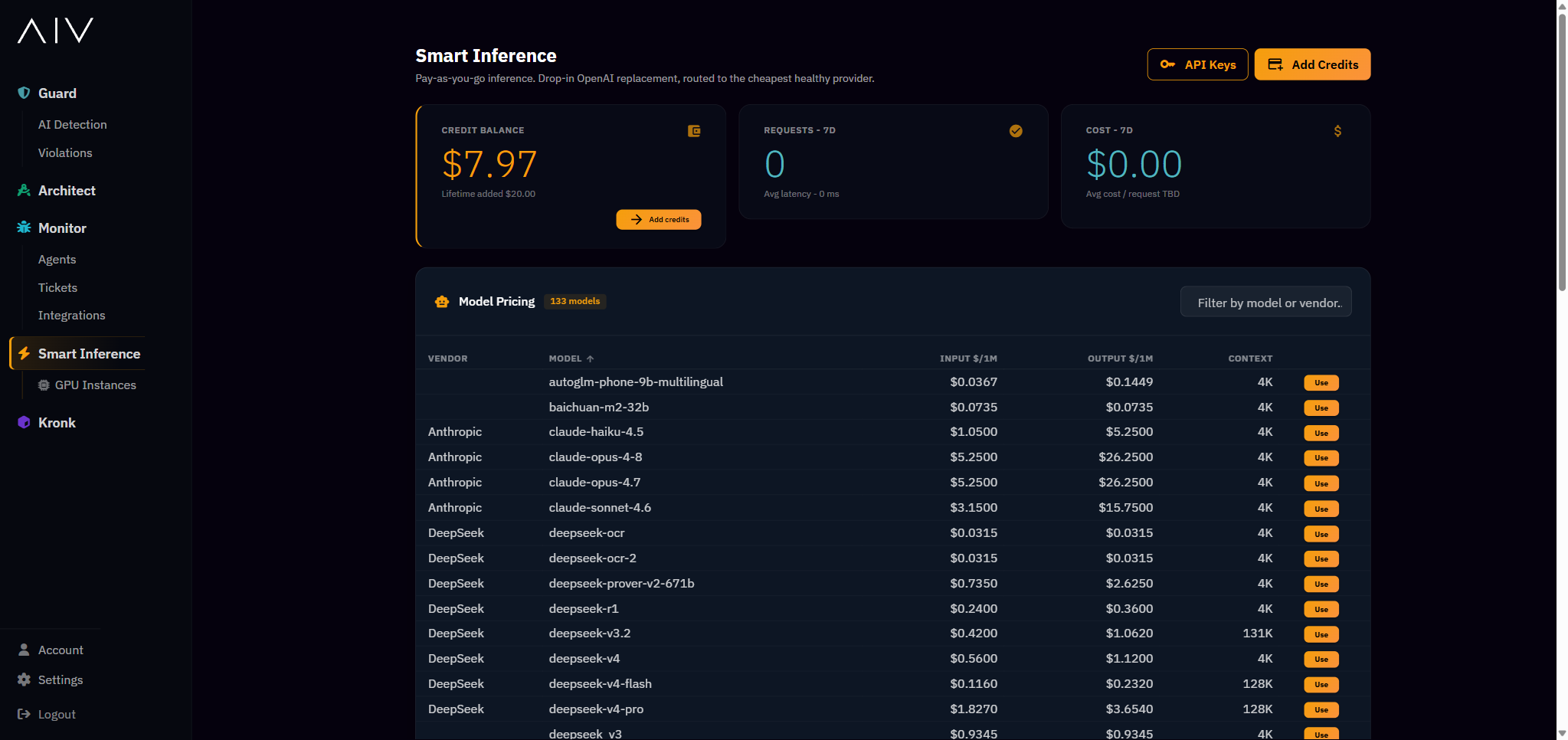
I Cut My AI Inference and GPU Costs in Half With One Line of Code
I built an AI product and forgot about the inference costs. For about a month. Then I built a router.

Securing AI Code: OWASP, GDPR, HIPAA, EU AI Act Checklist
A concrete, bookmarkable checklist for AI-generated code against OWASP Top 10, GDPR, HIPAA, and the EU AI Act, with the actual check for each item.

LiteLLM vs Smart Inference: Self-Hosted or Managed
A concrete look at what you gain and lose self-hosting LiteLLM versus using a managed router like Smart Inference, for teams routing open-weight models.

What Is a GPU Spot Instance? Explained Simply
A GPU spot instance is spare cloud GPU capacity sold at a steep discount. How spot pricing works, the interruption trade-off, and when to use it.

What Is an LLM Router? A Plain-English Guide
An LLM router sits between your app and multiple model providers, picking the best one per request. How it works, when you need one, and the trade-offs.